A fallen leaf.
Look for lines, edges, and patterns. Compare two leaves and see what you notice.
Try it on your next walk
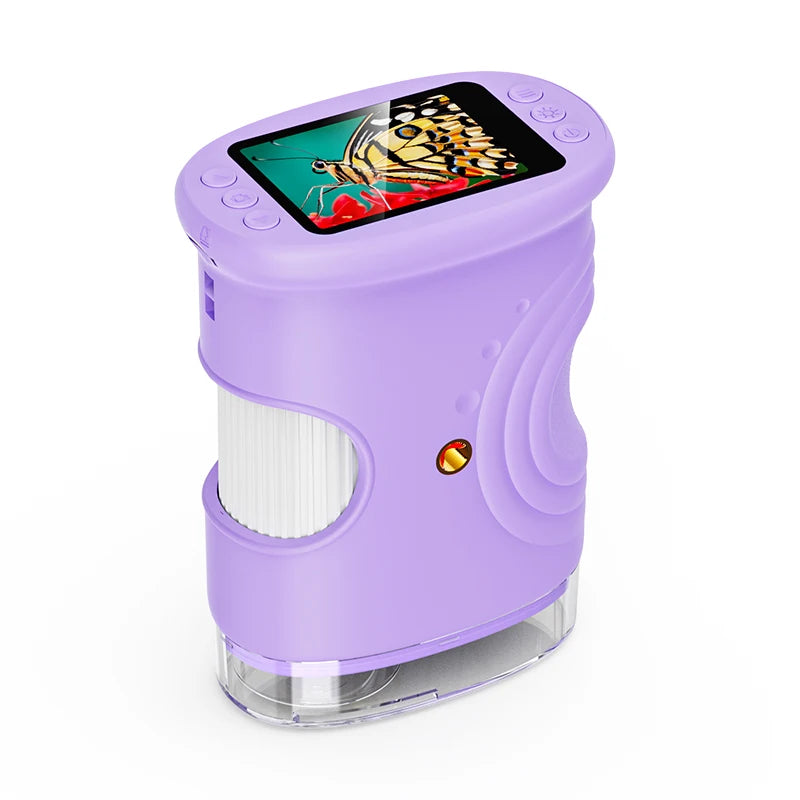
Product appearance shown by the supplier.
 Watch the 17-second demoSee an ordinary cloth up close
That’s a cleaning cloth. Look at those fibers. Pocket Explorer reveals the details hiding in everyday things, right on its built-in screen. No phone needed. Pick your color and get our free Discovery Notes. Start exploring at little field lab dot com.
Handheld digital microscope
Turn a leaf, a sweater, or a grain of salt into your next discovery. See it up close on the built-in screen—no phone or app needed.
30-day returns from delivery. Customers pay return shipping.
A separate memory card is required for video recording. No card is listed in the supplied kit.
Watch more product demos ↗Includes our free printable Discovery Notes.
The supplied kit lists the microscope, USB-C cable, lanyard, and manual. A memory card is not listed as included, so plan to supply your own. For video or extra storage, use a Class 10 or faster microSD/TF card up to 64GB.
Yes. The manual lists built-in storage for approximately 200 photos. A separate memory card is required for video recording. Internally stored photos cannot be transferred to other devices; use a memory card for photos you want to transfer. Photos are saved as JPG files and videos as AVI files.
No phone or app is needed for viewing on the built-in screen. Charge the microscope, turn it on, place it over a subject, and rotate the focus ring until the image is clear.
Start with dry, stationary objects such as fallen leaves, fabric, paper, and salt. Keep the lens and device dry. Leave living creatures in their habitat.
Product images include illustrative screen artwork. Your view depends on the subject, lighting, focus, and device settings.
US standard shipping is $8, or free on orders of $70 or more. Delivery timing varies by destination and fulfillment; contact support@littlefieldlab.com for a current estimate before ordering. Shipping policy. Return policy.
The ordinary gets interesting
You don't need an expedition. Start with three things you already have nearby.
Look for lines, edges, and patterns. Compare two leaves and see what you notice.
Take a closer look at the weave. How does cotton compare with a sweater?
Spread a few grains on dry paper. Explore their shapes, then sketch what you see.
Illustrations suggest activities; they are not microscope output.
Less setup. More looking.
A dry leaf, fabric, or a small everyday object is a great place to begin.
Place the microscope over your subject and adjust the focus while watching the screen.
Compare textures, draw what you see, and choose the next thing to explore together.
Take a closer look
Everyday objects. Unexpected details. Choose a short demo, press play, and turn on sound if you like.
A leaf, a sweater, a whole new perspective.
Your next discovery might be right in front of you. A leaf. Your favorite sweater. Everyday textures, seen up close. Meet Pocket Explorer from Little Field Lab. Turn the focus wheel and see what you find. Shop little field lab dot com.
Little details, a new perspective.
Look closer. There’s a whole world hiding in everyday things. Meet the Pocket Explorer from Little Field Lab. A handheld digital microscope with a built-in screen, adjustable lights, and manual focus. Turn a little curiosity into your next discovery. Explore at littlefieldlab.com.
An invitation to explore what's around you.
A gift for the endlessly curious. Fabric, leaves, and everyday objects become something new when you look closer. Pocket Explorer puts a digital microscope and a viewing screen right in your hand. Pick a color and start exploring with Little Field Lab. Shop littlefieldlab.com.
A closer look at the details
See it on the screen, adjust the light, and capture your discoveries.
Specifications are stated in the supplied manual. Battery life varies with use.
The supplier lists these items in the kit:
A memory card and wall adapter are not listed as included. Use a separate 5V/1A adapter for charging.
Free printable Discovery Notes with five activities to look, sketch, and explore together.
Open your Discovery Notes ↗A little inspiration to begin
Our printable Discovery Notes give curious minds a place to look, sketch, and ask “what next?”
Open the free field notesLittle Field Lab / No. 001
LOOK. WONDER. REPEAT.
Good questions
Use the USB-C cable with a separate 5V/1A power adapter. Fully charge before first use; the manual lists approximately 2 hours to charge and up to 2 hours of use. The indicator is red while charging and green when fully charged. An adult should supervise charging and follow the supplied battery instructions.
The manual states that it is not suitable for children under 36 months. Children should explore with an adult, who can help with focusing, charging, and handling the memory card and lanyard. Follow all warnings in the supplied manual.
The microscope combines optical and digital enlargement. The manual says the exact magnification cannot be read accurately, so we do not promise a specific optical magnification. The detail you see depends on the subject, lighting, focus, and zoom settings.
The Pocket Explorer is intended for casual discovery. It isn't sold as a professional laboratory instrument or a medical diagnostic device.
Use it in dry conditions, keep it away from water and direct sun through the lens, and follow the supplied instructions. Supervise children during use and charging.
No. The printable is optional inspiration. You can explore your own objects and keep your own notebook.
Visit our contact page and we'll help with your question.